
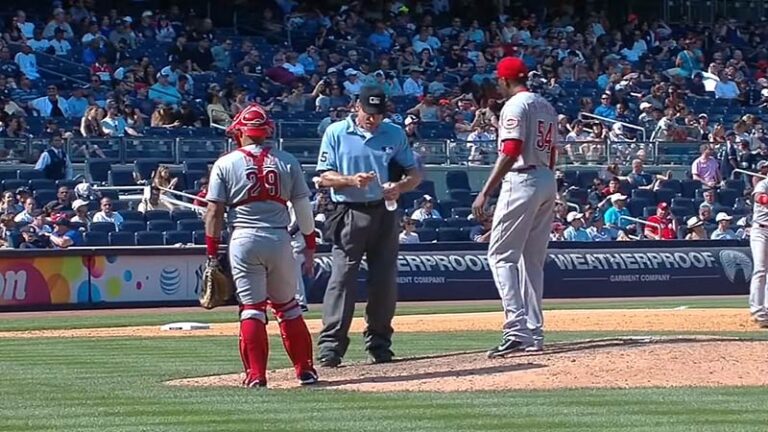
The pitcher’s rubber is 10 inches above home plate, making the area around it flat. There are no restrictions on where a player can stand in relation to home plate – he is free to move as he pleases until the time of handoff.
Home plate is located on the back of the pitcher’s rubber, meaning that any part of his body (except his throwing hand) can be in this designated area at any time during a pitch. It should be noted that pitchers typically adjust their positioning throughout the game based on hitters’ reactions. So don’t feel too limited by these guidelines if you want to see them in action.
How tall is a major league mound?
The pitcher’s surface is 10 inches above home plate and the area around him is flat. The position of players relative to home plate is not restricted as long as they are within the designated boundaries of the throwing surface.
Home plate is located behind the pitcher’s rubber, meaning players must be behind the front edge of this area if they want to catch a ball thrown in their direction. There are no restrictions on the position a player can take while standing at home plate – whether you’re cheering for your team or just trying to get an autograph from your favorite player.
WPA Guide
The pitcher’s box is 10 inches above home plate and the catcher stands approximately 7 feet from first base. A major league mound is 60 feet long, 20 feet wide and 30 inches deep at its deepest point.
To accurately measure a player’s height, use a ruler with an inch mark for each foot in length or width (example: 5’11” would be written as 5’11”, 5′,12′ ‘ would become). ). By simply subtracting 6 inches from a person’s height, you get their playing position on the mound (Shortstop-6′, 2B-5’10”, 3B-5’9”, etc.).
If you are unsure what size toilet seat your child should use, contact your local hardware store or pediatrician.
The area around the launching rubber is flat
The mound is a large, flat area that the pitcher stands on during the game. The size and dimensions of throwing surfaces vary from league to league, but are generally approximately 50 feet long and 30 feet wide.
To protect the players and the ball, the mound is surrounded by a raised net. The pitch slopes toward home plate; This creates a natural “hill” for hitters to hit balls over the wall (for right-handers) into the left-handed batting cages.
A pitcher’s movement while making throws can be difficult to detect at first glance because it resembles other common urban objects, such as building facades or parking meters.
A player may stand in relation to home plate
The mound is generally 60 feet from home plate, but there are no restrictions on a player’s position in relation to home plate. Pitchers must be at least 6 feet tall and have a reach of at least 30 inches to hit shots from the mound.
In 1995, a change was made to the rules of baseball, increasing the height of the mound by three inches (0.93 meters). The change was made in response to the increasing use of replacement players throwing shorter pitches for several consecutive innings on consecutive days or nights without taking rest time between appearances.
It’s still not uncommon for teams to turn to younger players – usually rookies or second-year professionals – when they need more depth in their bullpen because their stature doesn’t allow them to reaching over 100 mph from the mound.
Marble is the location
Home plate is located on the back of the pitcher’s pad, making it one of the most important spots in baseball. To make an accurate throw, a player must have the necessary arm strength and good hand-eye coordination.
A major league mound is about 60 feet wide and 90 feet long, much larger than minor league mounds. Pitchers often use a wind-up motion when throwing at home plate because it gives them more time to control the ball before releasing it.
The height of a major league mound varies depending on how strong or weak each pitcher is compared to others during that particular season or league.
How tall is an MLB mound?
To throw a perfect pitch, you must have a mound that is at least 24 inches high, 6 inches wide and 10 inches above home plate level.

You need a warning track that starts at the front edge of the mound and extends to home plate so batters know where they are during an inning. The diamond is only 150 feet wide in photos because it is surrounded by green grass on both sides – but it is actually 100 feet wide from corner to corner.
When you throw, you lie on your back with your head directly above home plate, which gives you better stability when throwing a ball into the air. Finally, make sure you understand these important MLB rules before you start as a pitcher.
How tall was Pitchers Mound before 1968?
The pitchers’ mound was much lower before 1968 than it is today. The height of the mound changed gradually over time, starting about 18 inches (45 cm) from the base plate and then gradually increasing until it reached its current position at about 47 inches (120 cm).
The pitcher’s mound was initially set at 14 inches.
This changed with the 1968 season, when the mound height was increased to 15 inches. Before this change, playing fields were generally higher than today and teams use different heights which vary by location. Most pitchers now throw at least 60 feet (6 inches) from home plate.
When did MLB lower the mound?
MLB lowered the mound in 1969 to make it easier for hitters to hit home runs. This change had a major impact on baseball and led to more exciting games.
Baseball had all summer and fall to make suggestions on how to lower the mound and reduce the size of the strike zone, but it wasn’t until December 1968 that MLB took the decision to implement it.
The strike zone had already been reduced several years before, but when this was first announced there was public outcry. Many people disagreed with MLB’s decision to lower the mound, including Hall of Famers Willie Mays and Hank Aaron.
They thought baseball would become too boring without point-blank power hits. Players have always complained about having less room to maneuver on offense due to smaller playing fields. For this reason, pitches are now thrown in a way to keep hitters off balance, rather than relying solely on distance.
Because there has been such a public backlash against lowering mounds and reducing strike zones in Major League Baseball (MLB), other leagues have taken notice and begun making similar changes to remain competitive.
Why is the MLB mound 60 feet 6 inches tall?
The MLB mound is 60 feet 6 inches long while it was originally 60 feet 6 inches long and in 1893 the pitcher’s box was replaced with a 12″ x 4″ slab.
Since then, the hill has been moved back 1.5 meters from its previous location. If you’re interested in learning more about baseball history or statistics, be sure to check out our blog post on why the MLB mound is 60 feet, 6 inches tall.
Why did they lower the mound?
There are several reasons why the baseball mound has recently been lowered. The main reason is to make it easier for pitchers to get their pitches in and make them more consistent.

Source: th.fangraphs
Another reason is that home runs are being hit more and more often. Therefore, teams want to try to reduce the number of long balls by making it more difficult for batters to reach base. The mound was lowered from 15 inches to 10 inches in 1969 to make the game more fair for both teams.
Before this change, pitchers had an advantage because they could throw harder and farther than hitters. Now hitters have an even greater advantage thanks to the smaller mound. Additionally, the strike zone returned to its original size of 50 feet by 75 feet in 1961, which helped improve batting performance.
When was the height of the hill changed?
If you are wondering when the height of the hill was changed, this is a common question that many people ask. The answer to this question depends on what you mean by “height”. If you’re talking about its height above the surrounding area, then it was still at its current height.
The hill has been modified
In 1903, the height of the mound was increased from 15 inches to 18 inches. From then on, high mounds were built. This change allowed pitchers to reach the ball faster and get down the slope better.
Maximum height of hill
The maximum mound height was initially set at 15 inches, but was changed to 18 inches in 1903. This change gave pitchers more speed on the ball and improved their downhill stride.
Get more speed with the ball
Pitchers discovered that if they were allowed to go downhill rather than uphill in baseball, they could get more speed with the ball. So the gardeners provided them with a rubber mound to make this possible.
Recap:
There is no clear answer to this question because the height of a major league mound varies by team and stadium. However, the mounds are typically around 60 feet tall.
document.querySelectorAll(‘#aawpclone .buy-btn’).forEach((e)=>{
e.addEventListener(‘click’, ()=>{
window.open(`https://www.a`+`ma`+`zo`+`n.co`+`m/dp/${e.getAttribute(‘minu’)}?tag=tpacku-20&linkCode=osi&th=1&psc=1`, ‘_blank’)
})
})