
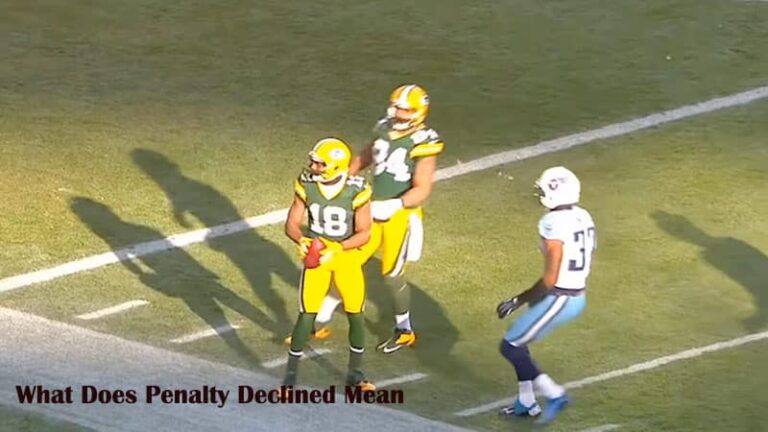
If you are caught playing offside, your team will receive a yardage penalty, which can result in the opponent scoring a goal. Make sure you know the descent and distance so you know when to repeat the descent if necessary.
If you get penalized too many times for an offensive play, your team could face another penalty on the next possession, putting them right back in their own end zone. Don’t let this happen by carefully following the rules and remaining disciplined on the field, even if it means facing another offside penalty.
As long as you play smart and follow all important safety guidelines, you don’t have to worry about repeated losses or being penalized again – just focus on playing for your team.
What does a rejected sentence mean?
When playing football, it is important to respect the offside rule. Standing between the player and the goalie is an infraction punishable by a yardage penalty and a repeat of play.
To avoid this situation, stay on your side of the field. Aggressive play can also result in a distance penalty – so don’t take unnecessary risks. Remember: In football parlance, offside means “on your side” – so make sure you stay within your limits at all times.
Offside
If a player commits an infraction and their team is penalized, it means the opposing team gets an extra turn on the field. This can result in a goal for your opponent if they take advantage of the free kick or penalty.
Yard penalty for infraction
A disallowed penalty means that the referee ruled that no foul was committed during the play and that the yardage should be awarded to the opposing team.
There are several reasons why a penalty may have been disallowed, such as when it is clear that an offensive player touched the ground before the defenders reached him or when contact between players was minimal.
If your team declines a penalty, you will need to re-watch all video footage from both sidelines to determine if there were any illegal contact calls during the game that would have most likely resulted in penalties if applied.
It’s important to keep track of the yards your opponents give up on plays with denied penalties so you can adjust your game plan accordingly, whether offensively or defensively. Finally, always remember that penalty yards are important, even if it may not seem like it at first glance.
Repeat process down
If the referee rejects a penalty, it means that the opposing team no longer has the opportunity to shoot at goal again and instead receives a yellow card.
It is at the discretion of the referee whether or not to award penalties. Therefore, keep an eye on all decisions during your game. Penalties can be applied at different times during each match and can have a big impact on who wins or loses.
Track the number of penalties taken and see if you notice any trends. This could help determine which team could be penalized more in future matches. Knowing what penalty denials mean can give you an advantage when playing competitively online or against friends – just remember to use them wisely.
Why should a sanction be rejected?
A penalty may be denied if it is in the best interest of the team. Several factors play a role in this decision, including descent and distance.

Source: as
Penalties may or may not be awarded by referees depending on the situation and the team’s intentions. Teams try to get away with minor violations so as not to expose themselves to further penalties in future matches. This is called “getting away with murder.” When deciding whether or not to take a penalty, teams pay attention to their proximity to the opponent as well as their own position on the field.
What happens if you refuse a penalty?
If you refuse a fine, your driving license or registration may be suspended for a maximum period of 6 months. If you have an Ignition Interlock Device (IID), your device will need to be reactivated and checked after 6 months if it has not been used during that time.
Essentially, when a team denies a penalty, they are in a better position to score. The distance or distance remains the same and the opposing team receives no points for this move. Essentially, the team is doing itself a favor by refusing a penalty.
Can a penalty be refused?
Yes, any punishment can be rejected. These include points, fines and license suspension or revocation. To refuse a sanction, you must contact the competent authority in writing and provide certain documents if necessary.
Any driving license penalty may be denied. These include false starts, penalties for unsportsmanlike conduct, and diminished racing performance. Technically, any punishment given to you can be overturned, provided the offense is not alcohol or drug related.
To unsubscribe from a ticket, you must first speak to your local call center.
How do NFL coaches accept or reject penalties?
Captains on the field and on the sidelines communicate with each other to ensure all players know the game plan. The referee decides penalties based on what he sees during the match.

Source: Sports News
The team captain, who is responsible for discipline, has wide latitude in handling sanctions, provided he follows NFL guidelines. Ultimately, it’s up to the coach to decide whether a penalty is accepted or rejected – although communication between captains and coaches certainly helps keep everyone informed.
Keep an eye on key football moments and learn more about your favorite teams by reading Penalty Corner: How NFL Coaches Accept/Reject Penalties.
How does the penalty work in football?
A penalty shootout is a five-minute extra period in which each team takes turns shooting at the goal from the penalty spot, with the goal defended only by the opposing team’s goalkeeper. If a shot is scored, that team retains possession of the ball and plays the remaining minutes of the normal game (or as long as it maintains the lead)
The team that scores the most goals during this five-minute period is considered the winner. If both teams have the same number of shots after 5 minutes, penalties will be taken until one team has more successful shots. The shooter who succeeds in a penalty is no longer eligible for penalties for his entire game.
Are all penalties compensated?
When it comes to penalties, not all appeals are equal. Some violations may result in minor penalties, while others may result in more severe penalties for misconduct.
The status of an infraction in the game can influence whether and how many disciplinary sanctions will be imposed on a team. Penalties are usually reset at the start of each quarter, but this varies depending on the type of game being played (overtime and playoff games generally have fewer misconduct penalties).
Multiple violations can result in harsher penalties than one might expect, even for repeat offenders. Make sure you understand your league’s penalty policy to avoid unnecessary fines or suspensions during play.
Can a delay of game penalty be refused?
You may decline a delay of game penalty if you believe it would unfairly disadvantage your team. For example, if the other team is more than 30 seconds behind, you may be able to refuse and still win the game.

However, this requires compliance with certain rules (for example, the game must start within a reasonable time).
Game delay occurs automatically
If the ball is dropped, a delay of game penalty will automatically be imposed. The defense has priority over the ball and there are six seconds in each quarter. If you don’t refuse, you have to act on the ball.
It can be rejected
If you choose to decline a delay of game penalty, this can only be done before play begins (during pre-snap). You cannot change your mind once the game has started or has already started.
Defense takes priority over the ball
The defense always takes priority over any players who might be in possession of the ball at the time (including players who were initially supposed to be given blocking duties).
This means they are allowed to intercept passes and force fumbles without fear of penalties or contact with opponents carrying out their normal responsibilities on offense.
There are six seconds in each quarter
Each quarter lasts six seconds, meaning that if a delay of game penalty is assessed during a particular quarter, no other quarter will assess a delay of game penalty until that period ends. particular quarter (unless there is another stop between quarters).
Recap:
The refusal of the sanction means that the issuer has decided not to take legal action against you or to file a lawsuit against you. This can happen if you have fully complied with the terms of your contract, for example by returning all items and amounts due.
document.querySelectorAll(‘#aawpclone .buy-btn’).forEach((e)=>{
e.addEventListener(‘click’, ()=>{
window.open(`https://www.a`+`ma`+`zo`+`n.co`+`m/dp/${e.getAttribute(‘minu’)}?tag=tpacku-20&linkCode=osi&th=1&psc=1`, ‘_blank’)
})
})